Red-Team Every AI Change.Fix What's Proven.

Automated adversarial testing of your LLM applications and AI agents, covering the prompts, retrieval, memory, tools and workflows that shape how they behave — rerun on demand or on every change.

Every Exploit Backed by Evidence
Prompt & Jailbreak Defense
OWASP GenAI Top 10 Testing
Continuous Regression Retesting

Two AI Targets, One Red Teaming Platform

Comprehensive adversarial coverage tailored to how your system interacts—from stateless LLM prompts to multi-step autonomous agent workflows.

LLM Application Red Teaming

Adversarially test the behavior introduced by an LLM within an application, including how it processes user instructions, retrieves context and returns output.

  • Direct and indirect prompt injection
  • Guardrail and instruction bypass
  • Sensitive information and system prompt exposure
  • RAG / retrieval manipulation and untrusted context
  • Unsafe output and downstream handling scenarios
  • Applicable OWASP LLM Application risks
Direct & Indirect Injection RAG & Context Poisoning

AI Agent Red Teaming

Test how an agent can be manipulated through its goals, instructions, memory, tools, permissions and connected real-world workflows.

  • Goal and instruction manipulation
  • Unsafe or unauthorized tool use
  • Excessive agency and permission boundaries
  • Memory/context poisoning and persistence
  • Tool, MCP and agent-to-agent attack paths
  • Applicable OWASP Agentic Application risks
Tool & MCP Boundaries Multi-Turn Goal Hijacking
Standardized Adversarial Coverage

OWASP-Aligned Red Teaming

Systematically evaluate your generative AI systems against recognized industry standards. Infiltra stress-tests prompts, RAG retrieval pipelines, and agent permissions against the OWASP Top 10 for LLMs and Agentic Applications.

Attack-Driven

Every test scenario actively provokes and stress-tests your model using real-world adversarial jailbreaks, multi-turn elicitation, and indirect prompt injection.

Active Exploitation Adversarial Payloads
Evidence-Backed

Confirmed vulnerabilities include full prompt-response interaction transcripts, exact payload sequences, and deterministic traces for immediate developer remediation.

Reproduction Traces Deterministic Proof
Repeatable Validation

Saved test profiles enable 1-click delta retesting after prompt adjustments, plus automated regression testing when foundation models or tool permissions change.

Delta Retesting Continuous Validation

Why Continuous AI Red Teaming?

Every assessment starts a lifecycle. Findings need retesting, and AI behavior must be revalidated whenever prompts, models, RAG context, or tool permissions change.

01
Initial Assessment Establish the baseline before or after production deployment.
02
Remediate Harden prompts, adjust tool permissions, and patch guardrails.
03
Delta Retest Verify that remediation closed the specific attack path.
04
Component Change Prompts, models, RAG sources, tools, permissions, or memory evolve.
05
Regression Test Revalidate that the application or agent still behaves within expected boundaries.
Model Changes Matter Too

A material change to the underlying foundation model can alter how instructions, guardrails, and tool-use decisions behave—even when your application code remains unchanged. A regression red-team run confirms that the application or agent still behaves securely within intended boundaries.

Adversarial AI Assurance

What Is AI Red Teaming?

AI red teaming is adversarial security testing designed specifically for generative AI systems. For LLM applications and autonomous AI agents, it means attacking the prompts, retrieved context, memory, tools, and permissions that shape system behavior—discovering where models can be coerced into exposing confidential data, bypassing guardrails, or executing unauthorized actions.

Infiltra automates this with intelligent red-team agents that execute OWASP-aligned attack scenarios, safely reproduce verified impact with complete interaction traces, and rerun identical profiles after prompt updates or model changes.

Infiltra unifies both software perimeters and generative AI deployments on one platform: this engine red-teams LLM Applications and AI Agents, while Web App & API Penetration Testing validates business logic, authentication, and conventional application perimeters.

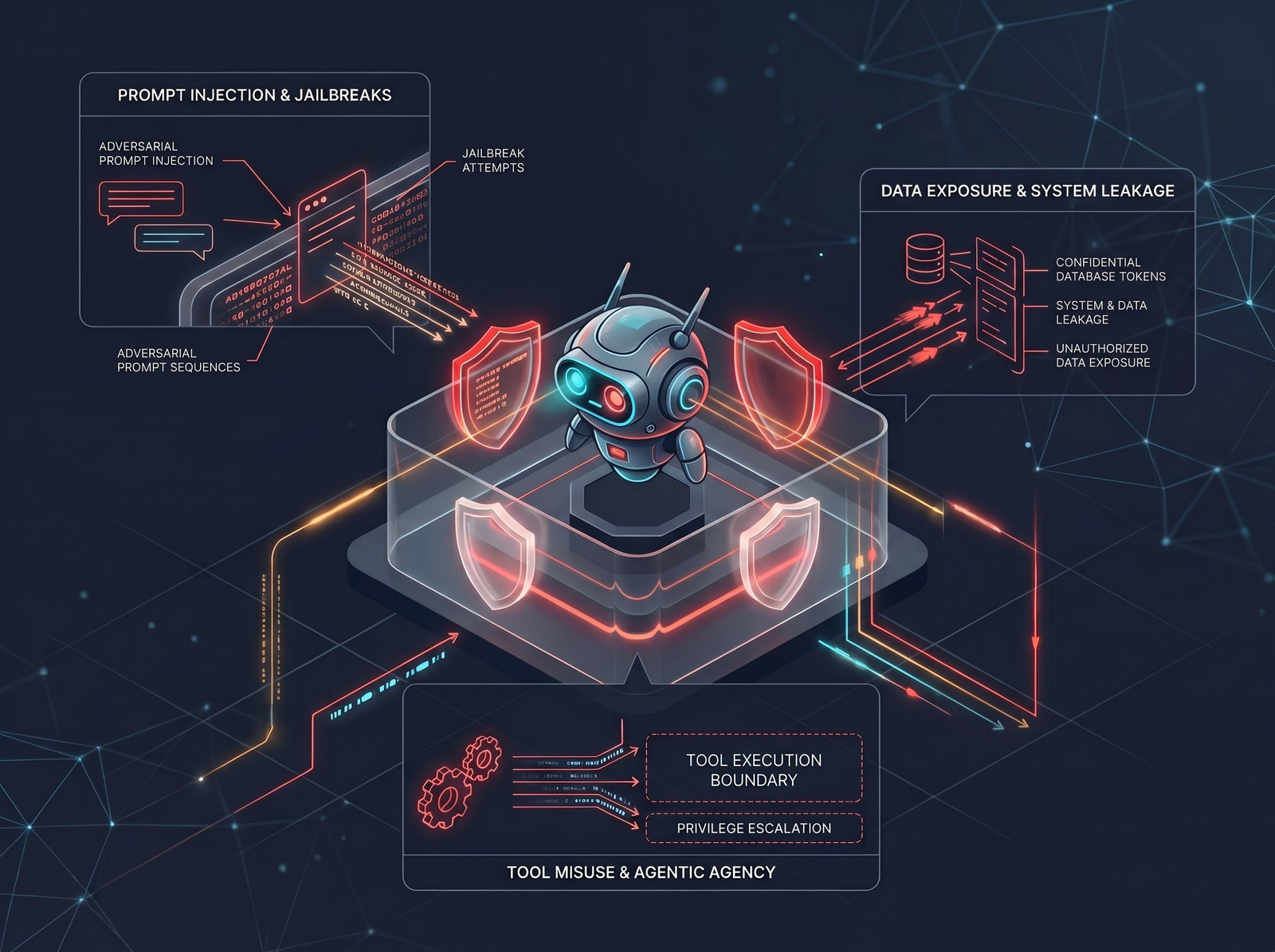
AI Red Teaming Attack Vectors: Prompt Injection & Jailbreaks, System & Data Leakage, and Tool Misuse & Agentic Agency

Mapped to the OWASP Top 10 for LLM Applications

Findings map directly to recognized OWASP categories, providing structured, defensible reporting that risk, engineering, and compliance teams can act on immediately.

OWASP Category What Infiltra Red Team Tests
LLM01: Prompt Injection
Direct & Indirect Injection
Direct user prompt overrides, instructions hidden in retrieved context (RAG), and multi-turn guardrail bypass attacks.
LLM02: Sensitive Information Disclosure
Data Leakage & PII Probing
Adversarial extraction of confidential training records, personal identifiable information (PII), API tokens, and internal credentials.
LLM05: Improper Output Handling
Downstream Execution Exploits
Payloads designed to trigger XSS, SQL injection, SSRF, or remote code execution when model responses pass into downstream systems.
LLM06: Excessive Agency
Tool Misuse & Privilege Escalation
Manipulating autonomous agents into calling unauthorized tools, exceeding API scopes, or triggering destructive real-world actions.
LLM07: System Prompt Leakage
System Instruction Extraction
Social engineering and meta-prompting payloads that extract proprietary instructions, internal guardrails, and embedded secrets.
LLM08: Vector & Embedding Weaknesses
RAG Poisoning & Context Tampering
Simulated poisoning of vector knowledge bases and similarity search indexes to coerce biased, hallucinated, or malicious outputs.
Agentic & MCP Threats
Multi-Turn Agent Hijacking
Testing Model Context Protocol (MCP) servers, agent-to-agent delegation boundaries, persistent memory poisoning, and goal drift.

Evidence for AI Governance

Repeatable red-team results give risk, compliance and audit teams documented evidence of how AI systems are tested.

NIST AI RMF

Supports the expectation that AI system security, trustworthiness, and resilience are systematically evaluated and documented.

ISO/IEC 42001

Test results and delta retests document how AI risks are assessed, treated, and monitored within your AI management system.

EU AI Act

Generates technical evidence supporting accuracy, robustness, and cybersecurity requirements for high-risk AI deployments.

Voluntary AI Safety Standard

Supports the Australian standard's core guardrail on rigorous testing of AI systems before and after production deployment.

Red-Team Your AI Every Time It Changes

Our subscription model allows you to run on-demand red-team assessments for new releases, remediation retests, and regression testing as your prompts, models, and workflows evolve.

Start Free
Continuous Validation When It Matters
  • Initial assessment before or after release.
  • Retest after remediation to verify fixed controls.
  • Regression testing after prompt, model, or tool-permission changes.
  • Evidence-backed reporting with clear reproduction traces.