Pentest Every Release.Prove Every Exploit.

Autonomous agents authenticate, reason through complex workflows, safely attempt exploitation, and prove real business impact across Web Applications and APIs — on demand or on every release.

Every Exploit Backed by Evidence
AI-Assisted Authentication
OWASP Top 10 Testing
1-Click Delta Retesting
ISM Guidance

Australia's Information Security Manual now calls for AI-augmented penetration testing (ISM-2119) at least every six months (ISM-2118). Infiltra's AI agents satisfy both requirements out of the box. Read the ISM guide →

From Discovery to Validated Exploitation

Autonomous agents discover complex attack surfaces, probe multi-step business logic, and validate exploitable vulnerabilities with deterministic proof.

Authenticated Testing & MFA Automation

Autonomous browser agents handle form, OAuth and complex multi-step logins, automate TOTP-based MFA, and maintain persistent state across deep application workflows.

AI-Assisted Authentication MFA Support
API Security Testing

Import OpenAPI, Swagger, or Postman collections to instantly map endpoints, parameter schemas, and test for BOLA, BFLA, parameter tampering, and injection flaws.

OpenAPI Postman Collection
Business Logic Testing

Probe multi-step workflows for step skipping, payment state manipulation, checkout bypasses, and access control gaps that cannot be caught by single-request DAST tools.

State Manipulation Workflow Bypasses
Multi-Step Reasoning

Agents maintain memory of prior responses, chaining requests across multiple user roles to prove cross-account data leakage and privilege escalation.

Role Switching Context Chaining
Exploit Validation

Every confirmed finding is safely verified with deterministic reproduction traces and sanitized proof payloads. Proves real business impact and eliminates triage noise from theoretical scanner alerts.

Proof of Impact Deterministic Traces
Delta Retesting

When developers patch a vulnerability, trigger a 1-click retest of the exact exploit payload to verify remediation before closing tickets or deploying to prod.

1-Click Retesting CI/CD Integration

How Web & API Testing Works

A 4-stage autonomous cycle designed for continuous engineering sprints.

01

Configure & Authenticate

Set target URLs, authenticate multi-role sessions (with MFA automation), define test scope and region. Import OpenAPI/Postman specs where available.

MFA Automation OpenAPI Specs
02

Surface & Workflow Discovery

Autonomous browser agents crawl authenticated paths, map stateful business workflows, endpoints, hidden parameter dependencies, and RBAC matrices.

Browser Agents RBAC Matrix
03

Exploit Reasoning & Logic Abuse

Agents attempt active exploitation across business logic, multi-step privilege escalation, BOLA/IDOR object flaws, and parameter tampering to validate real impact.

Proof of Exploit BOLA / IDOR
04

Evidence Report & Delta Retest

Receive verified, evidence-backed findings with step-by-step reproduction payloads and remediation code. Automatically retest fixed endpoints on demand.

Reproduction Traces Delta Retest
Autonomous Security Assurance

What Is AI Penetration Testing?

AI penetration testing deploys autonomous reasoning agents to execute continuous, adversarial security assessments across Web Applications and APIs. Unlike legacy vulnerability scanners that rely on static regex signatures, AI pentesting mimics an elite human penetration tester—authenticating, discovering complex application logic, and chaining multi-step exploits to prove real-world business impact.

Because assessments run on demand with continuous delta retesting, engineering and security teams can pentest on every production release, validate developer fixes within minutes, and eliminate triage noise with exploit-backed proof of impact.

Infiltra unifies both software perimeters and generative AI deployments on one platform: this engine tests Web Applications and APIs, while LLM & AI Red Teaming stress-tests chatbots, RAG pipelines, and autonomous AI agents.
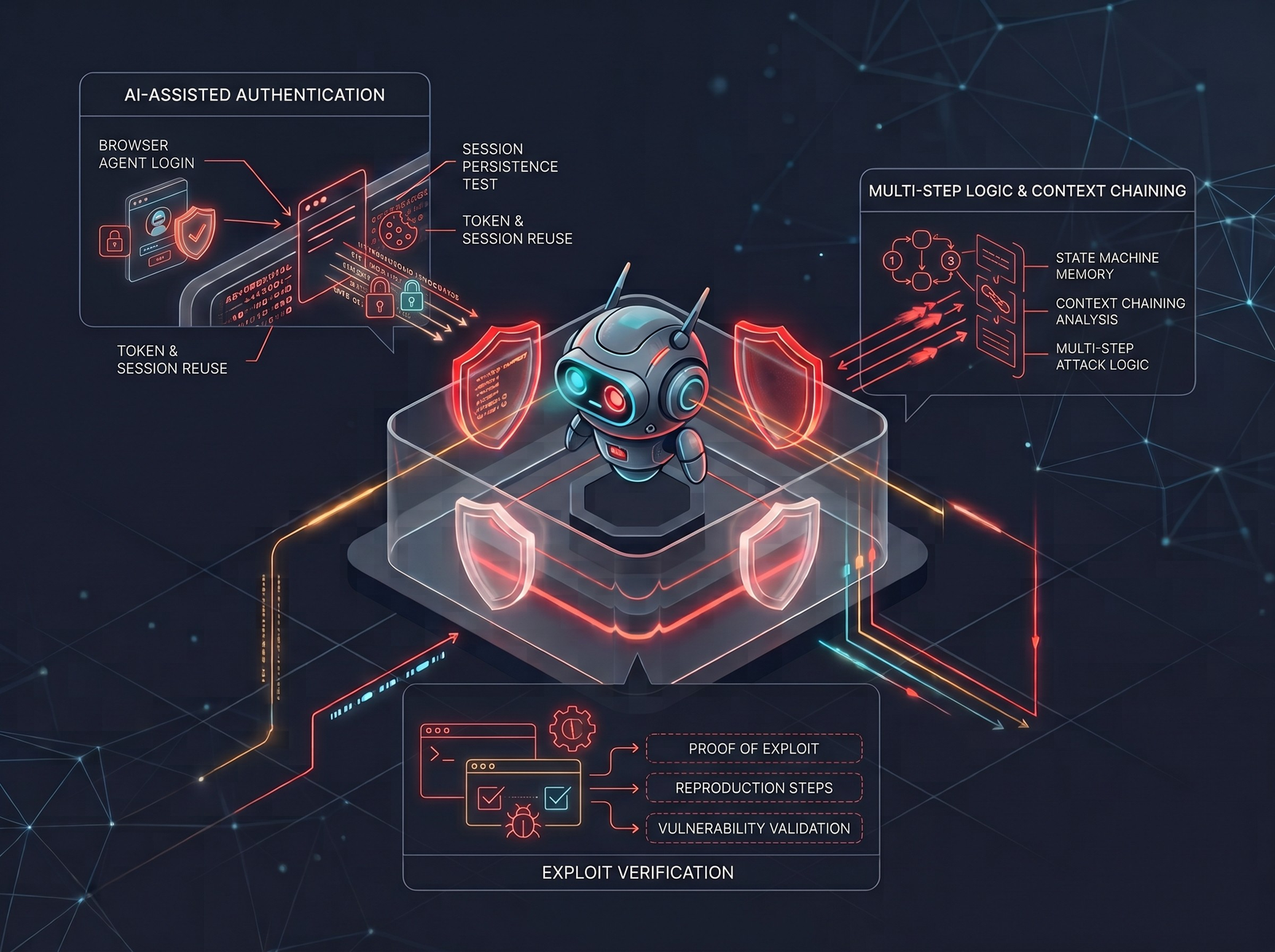
AI Penetration Testing Execution Architecture: AI-Assisted Authentication, Multi-Step Logic, and Exploit Verification

How AI Penetration Testing Compares

Where Infiltra fits alongside manual penetration tests and legacy vulnerability scanners.

Comparison Factor
Infiltra AI Penetration Testing Autonomous AI
Manual Penetration Test Vulnerability Scanner (DAST)
Time to Start
Minutes, self-serve
Configure targets, authenticate user sessions, and launch autonomous testing immediately with zero scoping lag.
Weeks of scoping
Lengthy SOW negotiations, scheduling lead times, and consultant availability.
Minutes
Fast initial setup, but often requires cumbersome manual login scripting.
Testing Frequency
On demand & every release
Continuous assessments triggered directly from CI/CD pipelines or sprint schedules.
1–2 times per year
Point-in-time reviews that leave new software releases untested for months.
Continuous
Runs recurring automated scans against public and staging environments.
Authenticated & Multi-Step Logic
Autonomous logic reasoning
Automates TOTP MFA, multi-role RBAC context chaining, and deep business logic testing.
Comprehensive, but variable
Deep analysis, but strictly constrained by allocated tester hours and scoped test paths.
Shallow single-request checks
Cannot maintain state across roles or uncover complex workflow logic flaws.
Exploit Validation
Deterministic proof of exploit
Safely executes exploits with step-by-step reproduction traces—eliminating scanner alert noise.
Verified by tester
Manually verified by human testers and delivered in static PDF report documentation.
Pattern & signature matching
Generates high volumes of theoretical warnings that burden engineering with triage.
Remediation Retesting
1-Click delta retesting
Instantly re-executes the exact exploit against fixed endpoints to verify remediation in minutes.
Delayed re-engagement
Typically requires a separate re-engagement fee and scheduling weeks after fixes are ready.
Full rescan required
Re-runs entire scan without targeted exploit reproduction to confirm specific fixes.
Pricing Model
Annual SaaS subscription
Predictable annual plan with monthly assessment allowances and continuous retesting.
Per engagement
High upfront cost ($10k–$30k+ per engagement) with additional billable fees for retesting.
Per-asset or IP license
Recurring subscription billed per scanned target domain, active seat, or IP address.

Evidence for Audits and Compliance

Penetration test evidence that security, engineering and audit teams can all use.

SOC 2 and ISO 27001

Audit-ready reports with evidence for every finding, plus retest results that show when each issue was fixed. Read the guide →

PCI DSS

PCI DSS requirement 11.4 calls for penetration testing at least once a year and after significant changes. On-demand assessments make testing after every significant change practical. Read the guide →

Letter of Attestation

Once fixes are verified, request a formal Letter of Attestation from the customer dashboard to share with customers, partners and auditors.

Run Penetration Testing Every Time Your Application Changes

Our subscription model allows you to run on-demand penetration tests for new releases, remediation retests, and regression validation.

Start free
Continuous Validation When It Matters
  • Initial assessment before or after release.
  • Retest after remediation.
  • Regression testing after application or AI-system changes.
  • Evidence-backed reporting and a clear path to closure.